


[Event Report] AMR Online Seminar “Current Status of Drug-Resistant Pertussis: Challenges and Prospects in Pediatric Infectious Disease Care” (May 15, 2025)
date : 9/3/2025
Tags: AMR

![[Event Report] AMR Online Seminar “Current Status of Drug-Resistant Pertussis: Challenges and Prospects in Pediatric Infectious Disease Care” (May 15, 2025)](https://hgpi.org/en/wp-content/uploads/sites/2/HGPI_AMR_Drug_Resistant_Pertussis_Seminar_20250515-1.jpg)
In response to the nationwide outbreak of pertussis (also known as whooping cough) in Japan that began in late 2024, Health and Global Policy Institute (HGPI) and AMR Alliance Japan hosted an online seminar on antimicrobial resistance (AMR) to hold a multifaceted reexamination of AMR from the perspective of pediatric medicine and to inform wider society on this topic. The seminar featured a lecture from Professor Kazunobu Ouchi, who serves as a Specially Appointed Professor at the Department of Nursing Childcare of Kawasaki University of Medical Welfare’s Faculty of Health and Welfare. In addition to the threats posed by macrolide-resistant pertussis, Professor Ouchi provided an overview of Japan’s National Action Plan on Antimicrobial Resistance and examined current conditions and issues for AMR control in the field of pediatric medicine.
<POINTS>
- Pertussis is a bacterial infection that can cause severe illness among newborns and infants. In response to the emergence of macrolide-resistant strains, Japan is now considering the expansion of boosters for expectant mothers and children.
- Japan has been advancing efforts to combat AMR based on the National Action Plan on Antimicrobial Resistance (NAP) formulated in 2016. Efforts to promote stewardship and reduce usage to specific numerical targets are currently underway.
- Urgent actions for AMR control in the field of pediatric medicine include ensuring thorough antimicrobial stewardship, educating infectious disease specialists, and promoting the development and approval of pediatric drugs and other pharmaceuticals. It will also be important to establish an environment in which these initiatives can be advanced in a sustainable manner.
■ Pertussis vaccination is extremely important, but circumstances surrounding outbreaks can change significantly depending on the application and type of vaccine. These factors are affecting the nationwide outbreak that began in late 2024.
Pertussis, or whooping cough, is an acute upper respiratory infection caused by Bordetella pertussis that spreads through droplet or contact transmission. Symptoms include cold symptoms and a distinctive cough with spasms. Complications in newborns and infants can be severe and can include pneumonia, encephalitis, or even death. A number of vaccines are effective at preventing pertussis and include the 3-in-1 diphtheria, pertussis, and tetanus (DTaP) combination vaccine; the 4-in-1 diphtheria, pertussis, tetanus, and polio (DTaP-IPV) combination vaccine, and the 5-in-1 diphtheria, pertussis, tetanus, polio, and Hib (DTaP-IPV-Hib) combination vaccine. In Japan, the standard period for the administration of initial routine vaccinations for infants is two to seven months of age, with three doses administered over intervals of 20 to 56 days. For boosters, it is standard to administer one dose from 6 to 18 months after initial vaccination, for a total of four doses. Optional boosters are available for children, adults, and expectant mothers.
The prevalence of pertussis in Japan has varied depending on the application and type of pertussis vaccines used. After World War II, Japan used a 3-in-1 vaccine called the DTwP vaccine, which included a whole-cell pertussis vaccine made by inactivating entire Bordetella pertussis organisms. Efforts to administer the DTwP vaccine progressed in the 1970s, which suppressed pertussis outbreaks. However, pertussis vaccinations were temporarily suspended in 1974 due to adverse reactions, causing coverage to drop from 78% to 14%. This resulted in a major pertussis outbreak from 1975 to 1979 that caused 31,070 infections and 113 deaths, which led to renewed recognition toward the importance of vaccination.
Today, Japan’s main vaccine for pertussis is an acellular vaccine containing pertussis toxin and part of the bacteria called the DTaP vaccine, which was introduced worldwide to replace the DTwP vaccine in 1981. DTaP has been confirmed to be highly effective and has few side effects, and it has made major contributions to pertussis control. On the other hand, due to reasons related to immunology and the fact that it is an acellular vaccine, the duration of protection provided by DTaP is shorter than that of whole-cell vaccines, at two to three years. It is also believed that pertussis outbreaks have been influenced by the implementation of infectious disease control measures like masking or the transition from a whole-cell vaccine to an acellular vaccine for routine vaccinations. Specifically, the major pertussis outbreak in the late 1970s resulted in immune memory that led to a high level of herd immunity throughout the 1980s. However, most people today only have immunity from the DTaP vaccine, so it is easier for a pertussis outbreak to occur today than it was in the 1980s or before. Additionally, infection control measures like handwashing and masking have been relaxed since COVID-19 was reclassified as a Category 5 infectious disease under the Act on the Prevention of Infectious Diseases and Medical Care for Patients with Infectious Diseases. While cases of pertussis and other upper respiratory tract infections had decreased for a time, these various factors caused cases to begin increasing again in around 2023, and as of May 2025, the case count remains high. Many of these cases have occurred in people ages 5 to 19, and it is believed that infections are spreading from children to family members and infants.
■ To control pertussis and macrolide-resistant pertussis, a system providing expectant mothers, newborns, and infants with a stable supply of vaccines must be established, antimicrobial stewardship must be promoted, and rapid testing methods to detect AMR bacteria must be developed.
Continuing to administer the 5-in-1 DTaP-IPV-Hib vaccine for infants starting at two months of age will be an important measure for controlling the spread of pertussis in Japan. To protect infants before they reach two months of age, it will also be necessary to recommend vaccinations for mothers and expectant mothers. In Western countries, in addition to vaccinating infants at two months of age, boosters are administered to young children (before entering elementary school), middle schoolers, and adults. Additionally, over 40 countries around the world have introduced routine vaccinations for expectant mothers to prevent pertussis infections among newborns and infants. Following examples set by other countries, Japan is currently considering the introduction of additional boosters, but one challenge for the success of such an initiative is ensuring a stable supply of vaccines.
While it is important to control pertussis itself through vaccinations, we must also pay attention to changes in how to treat pertussis due to the emergence of AMR bacteria. The first-line treatment for pertussis is macrolide antimicrobials. However, the emergence of macrolide-resistant strains of Bordetella pertussis has been reported in recent years, with numerous reports of resistance detected in 2025. The recommended forms of treatment for macrolide-resistant pertussis in adults are trimethoprim/sulfamethoxazole or fluoroquinolones. However, infants under the age of two months face a higher risk of severe jaundice, so it is preferable that they are treated with penicillin or other beta-lactams. Given these circumstances, in addition to developing or disseminating rapid diagnostic methods to detect AMR, such as nucleic acid amplification testing, treatment plans for macrolide-resistant Bordetella pertussis must also be established.
■ Cooperation in areas such as antimicrobial stewardship, drug discovery, R&D, and international collaboration will be essential in responding to the growing threat of AMR.
The World Health Organization (WHO) estimates that with no further action, deaths due to AMR will surpass 10 million people by 2050. In 2016, Japan established the National Action Plan on Antimicrobial Resistance (NAP) as a result of the G7 Ise-Shima Summit. Except for bacteria with carbapenem resistance, AMR bacteria are more prevalent in Japan than overseas, so measures must be taken. The 2016 NAP aimed to reduce the use of oral cephalosporins, fluoroquinolones, and macrolides by 50% compared to 2013, and despite the impact of the COVID-19 pandemic, Japan had achieved a 45% reduction by 2022. The new NAP formulated in 2023 set various numerical targets and objectives to promote AMR control through antimicrobial stewardship; reducing the use or ensuring the appropriate use of antimicrobials in livestock, fisheries, and veterinary medicine; R&D; drug discovery; and international cooperation.
■ In addition to appropriate diagnosis and treatment, advancing AMR control in the field of pediatric medicine will require an environment that spans multiple fields for efforts including promoting the development and approval of new antimicrobials or vaccines and training pediatric infectious disease specialists.
In addition to appropriate diagnosis and treatment, issues for pediatric AMR control include expanding surveillance to monitor emerging infectious diseases and trends in antimicrobial susceptibility; having adequate communication with parents regarding treatment plans; developing new antimicrobials, vaccines, and diagnostic methods; promoting antimicrobial stewardship among physicians involved in pediatrics; and training pediatric infectious disease specialists. Major challenges include delays in the development and approval of antimicrobials suitable for treating children and shortages of human resources for responding to infectious disease outbreaks in children. Regarding the former, when AMR bacteria emerge, it is best to secure as many usable antimicrobials as possible, but antimicrobials that are approved for pediatric use in Japan are limited. In fact, approx. 70% to 80% of drugs that are approved for pediatric use in the US have no such approval in Japan. One factor for this difference may be that many Western countries have introduced incentives for pediatric drug development, while direct incentives in Japan are limited. This may be hampering R&D.
Beyond the lack of options for antimicrobials that can be used in children, the shortage in infectious disease specialists in the field of pediatrics is another factor hindering AMR control. According to related academic societies, Japan needs at least 3,000 to 4,000 infectious disease specialists nationwide; however, their current number is only around 2,000. Among them, there are fewer than 300 pediatric infectious disease specialists. To address this situation, efforts are being made to expand premiums related to infectious disease control, to create permanent courses on infectious disease at universities, and to train pediatric infectious disease specialists through a program provided by the Japanese Society for Pediatric Infectious Diseases. Promoting the development of pharmaceuticals and diagnostic methods for children and securing sufficient pediatric and general infectious disease specialists will require improving environments in many areas including diagnosis and treatment in pediatric infectious disease, development and approval for new drugs, and human resource development.
■ A dialogue on vaccination and infectious disease control measures from the perspectives of pediatric medicine and maternal and child health
The latter half of the seminar featured a dialogue between Professor Kazunobu Ouchi and HGPI Fellow Ms. Kyoko Ama. Ms. Ama has been engaged in devoted efforts to improve pediatric care as a civil society representative on various national and local councils and committees. In this dialogue, she offered questions that represented the standpoints of those most affected.
What items should be prioritized when advancing vaccination programs for pertussis?
In principle, efforts to vaccinate children and expectant mothers should be advanced. In particular, focusing efforts on vaccinating expectant mothers will make it possible to save more lives because expectant mothers transfer antibodies to newborns. The transfer of antibodies means that vaccinating expectant mothers can simultaneously protect infants under two months of age, who are most at risk of severe infections. However, there is still the practical challenge of securing vaccines, so it will be necessary to move forward with a close eye on the balance between supply and demand.
What is the current situation surrounding macrolide-resistant Bordetella pertussis in Japan?
We only have partial knowledge regarding what proportion of domestic Bordetella pertussis strains possess macrolide resistance. A survey conducted in Tottori Prefecture found that 8 out of 9 infected people had AMR strains, but other surveys have reported that approx. 50% of strains retain susceptibility. Based on impressions from clinical settings, we estimate that approx. 50% of strains nationwide possess resistance. Efforts to collect strains and conduct susceptibility testing at academic societies and similar bodies are currently underway, and we expect to have more reliable data within a few months.
Why is education important in AMR control, and what are its effects?
Under the NAP, efforts to provide education on AMR in middle schools have been advancing since around 2020. People who learned about AMR in middle school are now reaching adulthood, and I feel that there is widespread understanding that “You should not take antibiotics when you do not need to” among members of that generation. I have the impression that their awareness and understanding is particularly advanced compared to kindergarten and nursery school staff, guardians, and members of other age groups. In the field of pediatric medicine, as well, fewer parents request unnecessary prescriptions for antibiotics compared to a decade ago due to continuous efforts to educate parents on AMR. I think the effects of efforts to raise awareness through education and learning support are steadily taking root.
How is the situation for training infectious disease specialists and improving the healthcare environment?
It is urgent that we address the shortage of pediatric infectious disease specialists and improve harsh working environments. Personally, I had an extremely trying experience during a past pertussis outbreak. No matter what we did, there were limits as to what could be done with ventilators, and physicians had to continue providing bag valve mask ventilation manually for two weeks straight. We did not know if the physicians would reach their physical limits before patients’ conditions would worsen. It will be important to improve such harsh working environments as much as possible and to build a healthcare provision system based on work style reform. We should establish an environment in which a greater number of physicians can support children in their capacity as professionals.
[Event Overview]
- Speakers (titles omitted):
Kazunobu Ouchi (Professor Emeritus, Kawasaki Medical School / Specially Appointed Professor, Department of Nursing Child Care, Faculty of Health and Welfare, Kawasaki University of Medical Welfare / Specially Appointed Director, Kawasaki Medical School General Medical Center and Kawasaki Medical School Hospital)
Kyoko Ama (Fellow, HGPI) - Date & Time: Thursday, May 15, 2025; 18:30-19:45 JST
- Format: Online (Zoom webinar)
- Language: Japanese
- Participation Fee: Free
■Profile:
Dr. Kazunobu Ouchi (Professor Emeritus, Kawasaki Medical School / Specially Appointed Professor, Department of Nursing Child Care, Faculty of Health and Welfare, Kawasaki University of Medical Welfare / Specially Appointed Director, Kawasaki Medical School General Medical Center and Kawasaki Medical School Hospital)
After graduating from Yamaguchi University School of Medicine in 1980, Dr. Kazunobu Ouchi began his career as a resident in Pediatrics at Okayama Medical Center. From 1986 to 1988, he worked as a Research Fellow in Pediatric Infectious Diseases at University of Oklahoma. Upon returning to Japan, he served as a Physician at the Pediatrics Department of National Kure Hospital Perinatal Medical Center in 1988 and then as Head of Pediatrics Department at Saiseikai Shimonoseki General Hospital in 1989. In 2002, he became a Professor of Pediatrics at Kawasaki Medical School and was appointed as Chief Professor of Pediatrics in 2006. He was awarded the title of Professor Emeritus at Kawasaki Medical School in 2021. Currently, he serves as a Specially Appointed Professor at the Department of Nursing Child Care, Faculty of Health and Welfare at Kawasaki University of Medical Welfare, and as a Specially Appointed Director at Kawasaki Medical School General Medical Center and Kawasaki Medical School Hospital. In his academic society activities, he served as Chairperson of Guideline Development Committee and President of both the Japanese Society for Pediatric Infectious Diseases and the Japanese Society of Travel and Health.
Ms. Kyoko Ama (Fellow, Health and Global Policy Institute)
Ms. Kyoko Ama was born in Tokyo in 1974. In April 2007, Ms. Ama established an association with the goal of improving the state of care for infants and young children by disseminating information on child and infant care to parents and guardians. The association became a general incorporated association called “Shiro Shoni Iryo Mamoro Kodomo-tachi” in July 2012. The association was dissolved on April 30, 2020. Ms. Ama also teaches childcare and childrearing as a part-time lecturer in a non-degree graduate program on early childhood education at Tokyo Rissho Junior College. She is the mother of three children. She has served on many committees in the past, in positions including Member, Roundtable on Promoting the Effective Use of Healthcare, Ministry of Health, Labour and Welfare (MHLW); Member, Study Group on Structuring Emergency and Disaster Healthcare Provision Systems, MHLW; Member, Study Group on Structuring Emergency Services, Fire and Disaster Management Agency, Ministry of Internal Affairs and Communications (MIC); Member, Study Group on Emergency Services, Tokyo Fire Department; Member, Council on Pediatric Care, Tokyo Metropolitan Government; and Member, Council for Promoting Public Awareness for Antimicrobial Resistance (AMR) Countermeasures, Cabinet Secretariat. She currently serves as a member of the Ministry of Education, Culture, Sports, Science and Technology (MEXT) Liaison and Coordination Committee for Revision of the Model Core Curriculum for Nursing Education and as the leader of the “Children and Healthcare” initiative.
Related Posts
-
2025-08-08
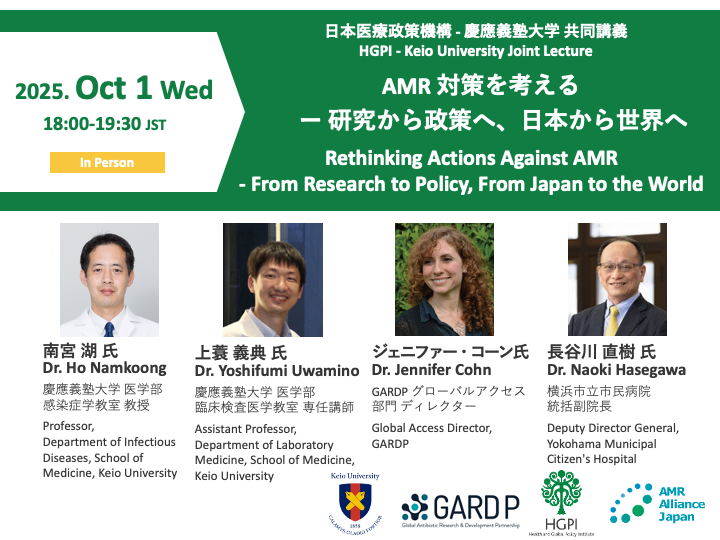
[Registration Closed] HGPI-Keio University Joint Lecture “Rethinking Actions Against AMR: From Research to Policy, From Japan to the World” (October 1, 2025)
-
2025-09-02
[Event Report] Public Health Seminar for Local Public Health Professionals: "AMR Measures to Protect Community Health - A Public Health Perspective" (July 16, 2025)
-
2025-09-01
[Discussion Points] International Dialogue "Fostering Community and Citizen-led Approaches to AMR: Lessons from Antibiotic Smart Sweden” (August 29, 2025)
-
2025-08-22
[Public Comment Submission] Comments on the Establishment of an Independent Panel on AMR (July 25, 2025)
-

2025-08-04
[Event Report] International Policy Dialogue “Advancing Action on AMR – Sustainable Policies, Financing, and Global Partnerships” (June 26, 2025)
-
2025-07-08
[Activity Report] “Nordic Health Days” at the Nordic Pavillion, Expo 2025 Osaka, Kansai, Japan (June 25-26, 2025, Yumeshima, Osaka)
-
2025-07-01
[Lived Experiences] AMR Control in Conflict Zones: Challenges and New Perspectives on AMR Control in Conflict Zones as Seen in Medical Practice in the Gaza Strip (July 1, 2025)
-
2025-06-30
[Event Report] HGPI-The University of Tokyo Joint Lecture “One Health, One Planet – Combating AMR for a Sustainable Future” (June 24, 2025)
Top Research & Recommendations Posts
- [Research Report] Perceptions, Knowledge, Actions and Perspectives of Healthcare Organizations in Japan in Relation to Climate Change and Health: A Cross-Sectional Study (November 13, 2025)
- [Research Report] The 2025 Public Opinion Survey on Healthcare in Japan (March 17, 2025)
- [Policy Recommendations] Developing a National Health and Climate Strategy for Japan (June 26, 2024)
- [Research Report] The 2023 Public Opinion Survey on Satisfaction in Healthcare in Japan and Healthcare Applications of Generative AI (January 11, 2024)
- [Research Report] Survey of Japanese Nursing Professionals Regarding Climate Change and Health (Final Version) (November 14, 2024)
- [Policy Recommendations] Mental Health Project: Recommendations on Three Issues in the Area of Mental Health (July 4, 2025)
- [Policy Recommendations] Reshaping Japan’s Immunization Policy for Life Course Coverage and Vaccine Equity: Challenges and Prospects for an Era of Prevention and Health Promotion (April 25, 2025)
- [Publication Report] Planetary Health Promotion Project “Issues Facing Planetary Health and the Role of the Health Sector” (May 10, 2023)
- [Research Report] Survey of Japanese Physicians Regarding Climate Change and Health (December 3, 2023)
- [Announcement] HGPI Joins Global Green and Healthy Hospitals (August 1, 2023)
Featured Posts
-
2025-11-13
[Registration Open] (Webinar) The 1st J-PEP Seminar – Initiating Policy Advocacy from Meaningful Involvement (December 8, 2025)
![[Registration Open] (Webinar) The 1st J-PEP Seminar – Initiating Policy Advocacy from Meaningful Involvement (December 8, 2025)](https://hgpi.org/en/wp-content/uploads/sites/2/mip-ncd-20251208-top.png)
-
2025-12-01
[Policy Recommendations] Recommendations on Strategic Investments in Policies for Brain Health to Revitalize Japan: Hopes for the New Administration (December 1, 2025)
![[Policy Recommendations] Recommendations on Strategic Investments in Policies for Brain Health to Revitalize Japan: Hopes for the New Administration (December 1, 2025)](https://hgpi.org/en/wp-content/uploads/sites/2/HGPI_20251201_Recommendations-on-Strategic-Investments-in-Policies-for-Brain-Health.png)
